- unwind ai
- Posts
- Vercel Built a Programming Language for AI Agents
Vercel Built a Programming Language for AI Agents
+ Garry Tan’s agent brain, Codex on mobile, and a $1.3M agent bill


Shubham Saboo & Gargi Gupta
May 18, 2026
I was looking at today’s updates and kept coming back to the Vercel one.
A programming language built with AI agents in mind sounds a little ridiculous at first. Like, do agents really need their own language now?
But then you look at the rest of today’s news: Garry Tan’s knowledge brain for his personal agents, Codex on mobile, and Peter Steinberger’s $1.3M monthly token spend.
Suddenly, it feels less ridiculous.
If agents are going to do real work, people are going to build weird new infrastructure around them. Some of it will be overkill. Some of it will probably become the new normal.
Today’s top AI Highlights:
Vercel built a programming language for AI agents
Garry Tan open-sourced the brain running his AI agents
LiteLLM launches sandboxes for agent fleets
Peter Steinberger spent $1.3M in OpenAI tokens in 30 days
Codex crossed 4M weekly users and landed on mobile
& so much more!
Read time: 3 mins
AI Tutorial
HTTP is a primitive. JSON is a primitive. /goal is becoming one for coding agents.
A few weeks ago, OpenAI's Codex CLI added /goal as a way to give the coding worker a job with a defined done state. Claude Code added it this week.
Hermes Agent, the orchestrator I run on a Mac Mini to coordinate work between coding workers, has had /goal built in for a while.
This guide walks through what /goal actually is, the three roles in a multi-agent setup, a real end-to-end run, the verification rule, and how to run goals in parallel without workers stepping on each other.
Latest Developments
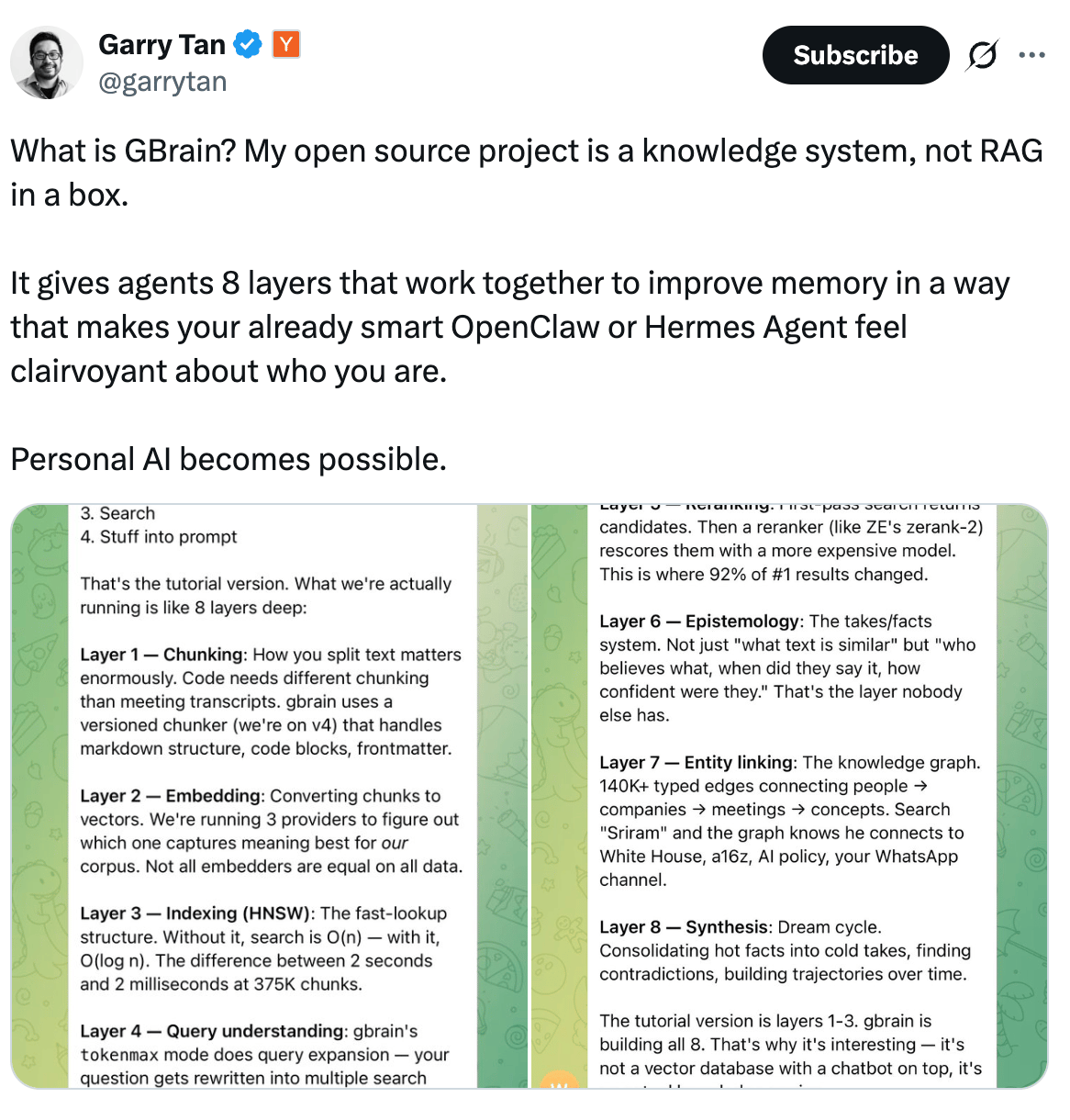
Garry Tan’s gstack made your AI agent ship code like a sprint team. Now, he open-sourced the knowledge system that powers his personal AI agents.
GBrain is not a notes app or a RAG pipeline. It's a structured, self-maintaining knowledge brain that currently holds 17,000+ pages, tracks 4,000+ people, and runs 21 autonomous cron jobs. Garry built it in 12 days.
The core idea is great: instead of re-deriving knowledge from scratch every query (like RAG does), GBrain pre-computes and maintains a "compiled truth" for every entity. Your agent gets richer context every time, and the whole thing compounds daily as it ingests meetings, emails, and calls. You wake up, and the brain is smarter than when you went to bed.
Key Highlights:
MECE knowledge structure - Everything is organized into clean categories: people, companies, deals, meetings, projects, concepts, originals, and media. Each page has a compiled summary on top and an append-only evidence trail below.
Self-wiring graph - Every page-write automatically extracts entity references and creates typed links (attended, works_at, invested_in) with zero LLM calls. Ask "who works at Acme AI?" and get answers vector search alone can't reach.
34 built-in skills - From signal detection to content ingestion to research synthesis. Intelligence lives in markdown skill files, not the runtime. This is how Garry's agents know how to do things, not just remember things.
Auto-enrichment tiers - Mention someone once, they get a stub. Three mentions triggers web enrichment. Meet them in person or mention them 8+ times, and the full research pipeline kicks in. The brain decides how much attention someone deserves.
Usage - Works as a standalone CLI, an MCP server for Claude Code and Cursor, or a one-click deploy on OpenClaw or Railway. Check it out at github.com/garrytan/gbrain.
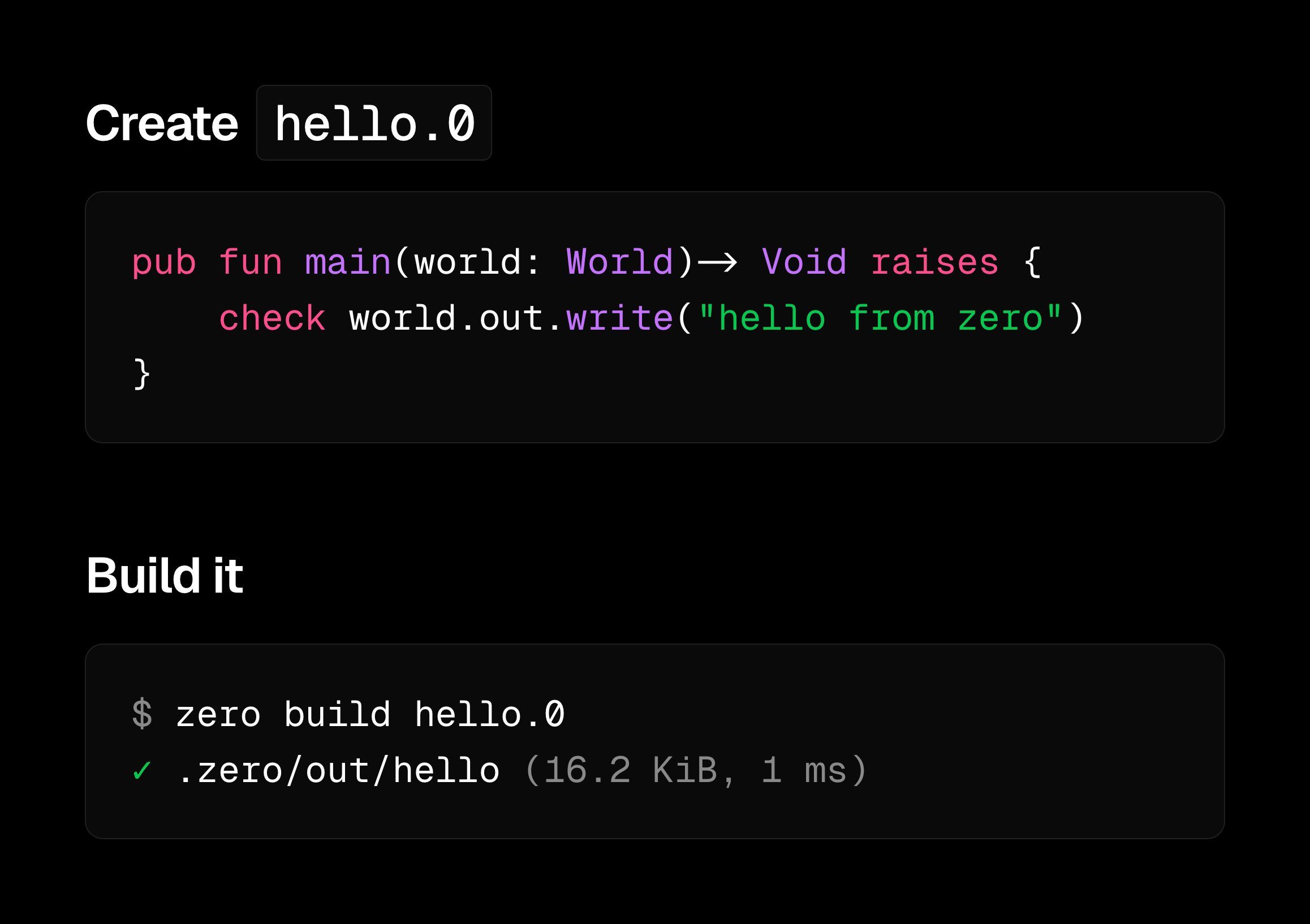
Programming languages were designed for humans and then retrofitted for AI. Chris Tate from Vercel just changed that.
Zero is a new systems language where AI agents are first-class users of the entire toolchain. Compiler errors come back as structured JSON with stable error codes and fix suggestions that agents can parse and act on programmatically.
Think of it as a language where the compiler talks to your agent the same way a senior engineer talks to a junior one: here's what's wrong, here's the error code, here's exactly how to fix it.
Still experimental, but the idea is genuinely novel. And the fact that it's coming from Vercel, not a random weekend project, means there's real conviction behind it.
Key Highlights:
Structured diagnostics - Every compiler error returns JSON with stable codes, line locations, and repair metadata. No more regex-parsing error messages. Agents can read errors and fix code without scraping human-readable text.
Tiny output footprint - Compiles down to extremely small native binaries with no garbage collector, event loop, and hidden runtime overhead. Think CLI tools and serverless functions.
Full CLI toolchain - One command handles check, build, run, test, format, inspect, dependency graphs, and docs. Everything an agent needs in one place, all machine-readable output.
Human-readable too - Despite being agent-first, the syntax is clean and readable. File extension is .0, which is a fun touch.
Try it now - Zero is open-source (Apache 2.0) from Vercel. Check it out on GitHub and zerolang.ai.
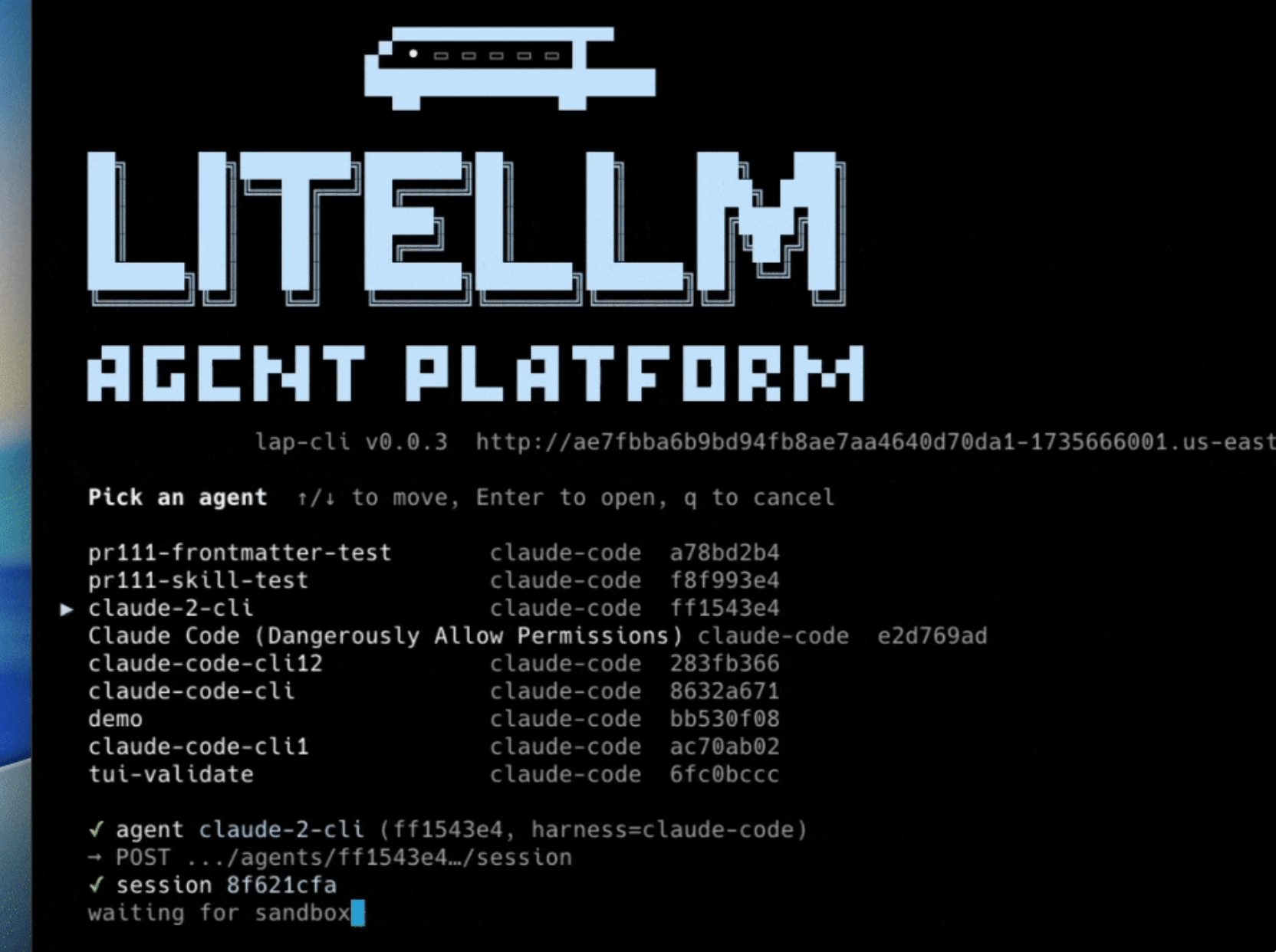
The team behind LiteLLM just shipped something bigger: a full platform for running fleets of coding agents in isolated Kubernetes sandboxes.
Each agent session gets its own fresh pod. Your real API keys never touch agent code.
A great feature is the credential vault. Agents only see stub tokens, and the platform transparently swaps in real secrets on every outbound connection.
If you're scaling from one coding agent to a team of them, this makes it super safe.
Key Highlights:
Agent-agnostic sandboxes - First-class support for Claude Code, Codex, and Hermes agents, all running in isolated pods that persist for 24 hours after you detach.
Credential vault - Agents never see your real API keys. The vault injects real secrets transparently on outbound connections, so a rogue agent can't leak anything. This alone is worth the setup.
Terminal-first workflow - The CLI lets you open a sandbox, attach your terminal, do your work, and Ctrl-D to detach. Simple and clean.
Full developer API - Create agents, open sessions, send messages, and read replies, all via REST. Build your own orchestration on top.
Open source and self-hostable - MIT licensed with local dev support and a production deploy path on AWS. Check it out at github.com/BerriAI/litellm-agent-platform.
Quick Bites
Peter Steinberger spent $1.3M in API tokens in 30 days
Peter Steinberger, creator of OpenClaw and now an OpenAI employee, casually revealed he burned through $1.3M worth of API tokens in a single month. That's roughly $20K per day, mostly on GPT-5.5 powering agents that manage the OpenClaw repo. Yes, he almost certainly has unlimited access as an OpenAI employee, so this isn't out of pocket. The number is wild, but the useful part is what it says about agent economics. Once agents run continuously, token spend becomes infrastructure, not just API usage
Codex hits 4M+ weekly users, now on Mobile
OpenAI's coding agent Codex just crossed 4 million weekly active users and is now available on iOS and Android through the ChatGPT app. You can kick off coding tasks, review diffs, and approve PRs from your phone. The "desk-only" constraint for AI-assisted coding is officially gone. 4M WAU also makes it one of the most widely adopted coding agents by a wide margin.
AI model built for deterministic dev tasks
Interfaze is a new model architecture that takes a fundamentally different approach. Instead of one autoregressive model doing everything, it breaks tasks into deterministic sub-steps like OCR, web search, classification, extraction, and then orchestrates purpose-built models for each. The result is structured output accuracy that beats GPT-5.4-Mini and matches Gemini-3-Flash. It's OpenAI SDK-compatible, comes with built-in web search from its own crawler, and runs tasks like audio transcription (1h 35m podcast in ~50 seconds) and document OCR natively. Free tier available at interfaze.ai.
ChatGPT now wants to manage your personal finance
OpenAI launched a personal finance experience in ChatGPT for Pro users in the U.S. Connect your bank accounts via Plaid, and ChatGPT gives you a spending dashboard, subscription tracker, and financial guidance grounded in your transaction data. The before/after examples are genuinely compelling, going from generic "save more money" advice vs. "cap dining at $450/month based on your Feb-May spend." OpenAI has also partnered with Intuit that signals the next step: actionable finance, like applying for credit cards and scheduling tax appointments directly from chat.
Tools of the Trade
Clawpatch: Code review for agent-written code. It maps a repo into semantic slices like routes, commands, packages, and tests, then reviews bounded contexts instead of isolated files.
Semble: Code search built specifically for AI coding agents. Instead of dumping entire files into context, Semble indexes your repo and returns only the relevant snippets, using 98% fewer tokens than grep-and-read. Drop-in MCP server for Claude Code, Codex, and Cursor.
Learning Opportunities: A Claude Code and Codex plugin that pauses after significant coding work and offers short, evidence-based learning exercises. The idea: if an AI agent writes your code, you should still understand what it did and why. Turns AI-assisted coding into actual skill building.
Awesome LLM Apps (111k+ 🌟 ) - A curated collection of LLM apps with RAG, AI Agents, multi-agent teams, MCP, voice agents, and more. The apps use models from OpenAI, Anthropic, Google, and open-source models like DeepSeek, Qwen, and Llama that you can run locally on your computer.
(Now accepting GitHub sponsorships)

That’s all for today! See you tomorrow with more such AI-filled content.
Don’t forget to share this newsletter on your social channels and tag Unwind AI to support us!
PS: We curate this AI newsletter every day for FREE, your support is what keeps us going. If you find value in what you read, share it with at least one, two (or 20) of your friends 😉
Reply