- unwind ai
- Posts
- Vercel Releases the "npm" of Agent Skills
Vercel Releases the "npm" of Agent Skills
+ Open Claude Cowork that connects with 500+ apps


Shubham Saboo & Gargi Gupta
January 20, 2026
In partnership with

Today’s top AI Highlights:
& so much more!
Read time: 3 mins
AI Tutorial
Evaluating startup investments requires hours of research across multiple domains - company analysis, market research, financial modeling, and risk assessment. This setup literally automates this entire workflow with AI agents that work together like a real investment team.
In this tutorial, you'll build an AI Due Diligence Agent Team using Google's Agent Development Kit (ADK) and Gemini 3 models, and Nano Banana.
This 7-agent team researches any startup (from early-stage unknowns to well-funded companies), analyzes the market, builds financial projections, assesses risks, and generates professional investment reports - all autonomously with seamless handoffs and a sophisticated analysis with reports.

We share hands-on tutorials like this every week, designed to help you stay ahead in the world of AI. If you're serious about leveling up your AI skills and staying ahead of the curve, subscribe now and be the first to access our latest tutorials.
Latest Developments

Claude Cowork was just released, and open source is already iterating faster than enterprise can price.
Just five days later, Composio shipped Open Claude Cowork, a free, open-source desktop agent built using Claude Code itself, because Cowork's $200/month subscription is too steep.
Open Claude Cowork is an Electron-based desktop app that connects Claude Agent SDK with Composio's Tool Router, giving you local file access plus on-demand connections to 500+ third-party apps.
The demo showcases this perfectly: it scans your laptop for unfinished projects and automatically logs them into a Notion database with completion status.
Key Highlights:
LLM Support - Switch between Claude Agent SDK (Opus/Sonnet/Haiku 4.5) and Opencode SDK for routing to multiple LLM providers, including GPT-5, Grok, and GLM through a single interface.
Tool Router Integration - Composio's MCP-based Tool Router handles authentication, tool discovery, and execution across Gmail, Slack, GitHub, Google Drive, and 500+ apps without flooding the context window with tool definitions.
Real-Time Streaming - Server-Sent Events deliver token-by-token responses with live tool call visualization, showing exactly what the agent is doing as it executes actions across local files and cloud services.
Introducing the first AI-native CRM

Connect your email, and you’ll instantly get a CRM with enriched customer insights and a platform that grows with your business.
With AI at the core, Attio lets you:
Prospect and route leads with research agents
Get real-time insights during customer calls
Build powerful automations for your complex workflows
Join industry leaders like Granola, Taskrabbit, Flatfile and more.
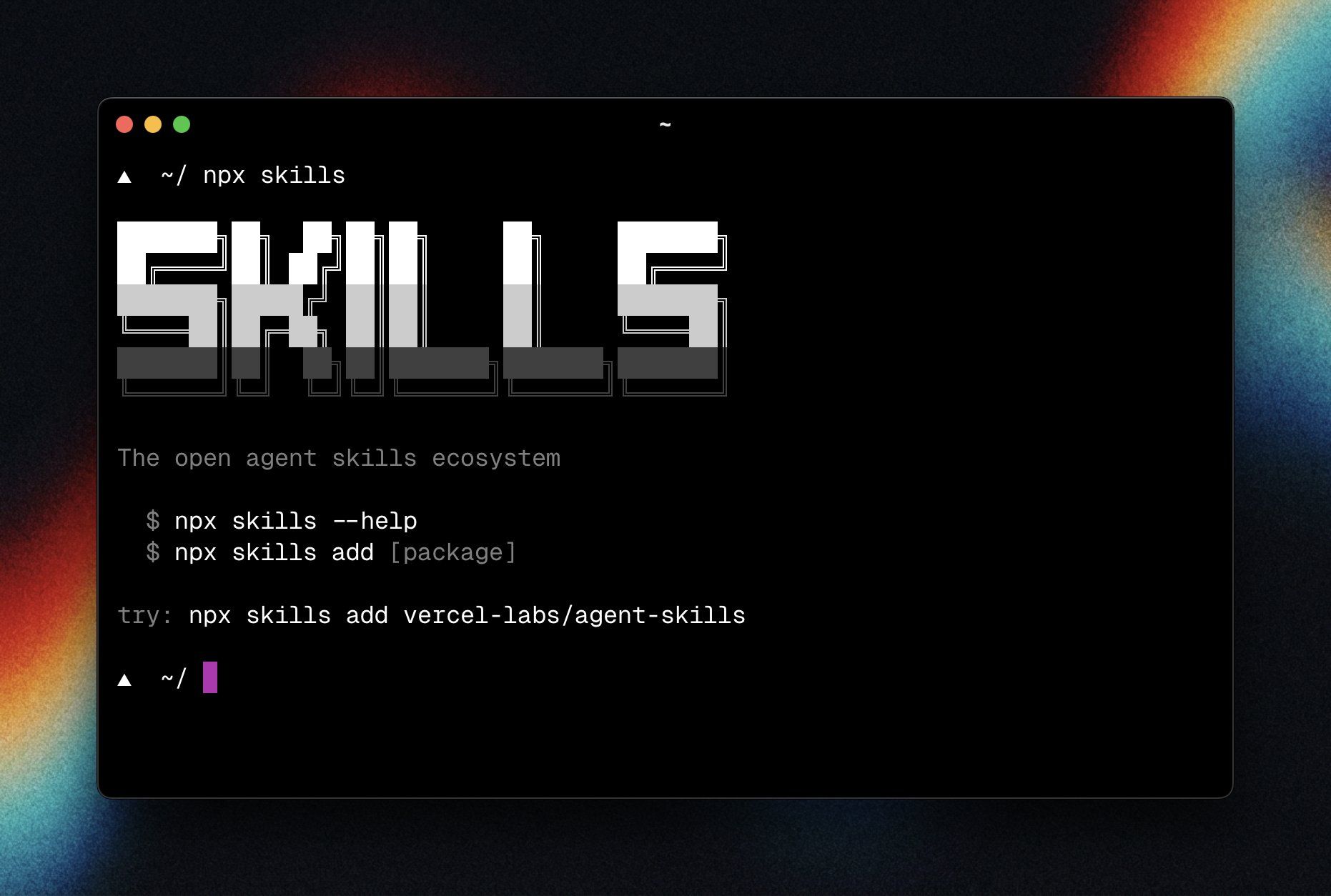
Installing AI capabilities just became as simple as npm install.
Vercel dropped a CLI tool that lets you add Skills to AI agents the same way developers add packages to projects.
No configuration, no manual setup, just npx skills i vercel-labs/agent-skills And you're done.
Here's what makes this interesting: Agent Skills started as Anthropic's internal format for teaching Claude specialized tasks, then became an open standard. Now Vercel built the distribution layer: a package manager that works across any agent supporting the standard.
You write instructions once (in a SKILL.md file), package them in a folder, and every compatible agent can use them. It's the same portability concept that made npm essential for JavaScript, applied to AI workflows.
Key Highlights:
Cross-Platform Distribution - The CLI pulls skills from GitHub repositories and installs them into
~/.claude/skillsor.github/skillsdepending on your agent. Works with Claude Code, GitHub Copilot, VS Code, and any tool that implements the Agent Skills spec at agentskills.io.Agent-Agnostic - Organizations can create internal skill repositories for company-specific workflows like "review code using our security checklist" or "generate reports following brand guidelines." The same skill works whether engineers use Claude Code or designers use another compatible agent.
Example Repository - Vercel's
agent-skillsrepo includes production-tested capabilities: React/Next.js best practices (40+ rules), web design audits (100+ accessibility checks), and automated Vercel deployments. Each skill includes documentation, example usage, and the actual scripts agents execute.
Quick Bites
ChatGPT Go goes global, Ads follow for Free users
After piloting ChatGPT Go in India at ₹399/month and watching paid subscribers double, OpenAI just rolled out its $8 tier globally, including the US, which ironically got it last. The strategy's working: 171 countries now have access to GPT-5.2 Instant with 10x message capacity, and adoption in low-income markets is growing 4x faster than high-income ones. It's textbook product-market fit for emerging economies, where a $20/month subscription is a non-starter but $4-5 actually makes sense.
And then there's the ad situation that broke X over the weekend! OpenAI “plans” to test ads in Free and Go tiers (US only, for now) despite Sam Altman's previous "I hate ads" stance. The backlash was predictable and overblown. Reality check: with only 35 million paying subscribers out of 800 million weekly users and a $17B+ burn rate, OpenAI needs other revenue sources. Their principles seem solid: ads won't touch responses, data stays private, no targeting kids or sensitive topics. As long as they keep ads out of the actual answers, this is fine. The company needs to survive, users get to keep using it for free, and Plus/Pro subscribers stay ad-free. Everyone calm down!
Z.ai’s GLM-4.7-Flash for local coding and agentic tasks
China's Z.ai just dropped GLM-4.7-Flash, a 30B model that crushes benchmarks you'd expect from much larger models. It hits 59.2% on SWE-bench Verified and 79.5 on agentic tool-use bench - while staying light enough for local deployment. Beyond coding and agentic tasks, it handles creative writing, translation, and roleplay, making it surprisingly versatile for local deployment. Available now on HuggingFace with MIT license and support for vLLM and SGLang.
Gemini gets access to your Google life for next-gen Personal Intelligence
You can now personalize Gemini by connecting Google apps with a single tap. The new Personal Intelligence feature lets Gemini tap into Gmail, Photos, YouTube, and Search to answer questions like "What's my license plate number?" by scanning your photos or "Where should we vacation?" by analyzing your past trips and preferences. Gemini will try to reference your connected sources. If it doesn’t, you can ask it for more information. It's opt-in and doesn't train directly on your personal data. Rolling out now to AI Pro and Ultra subscribers in the US.
LangChain Polly: An agent that debugs your agents
LangChain just shipped an agent that debugs other agents, and the meta-recursion is somehow not the interesting part here. Polly lives inside LangSmith and does what you'd expect from an AI agent engineer: analyzes traces with hundreds of steps, spots failure patterns across multi-turn conversations, and rewrites system prompts based on natural language descriptions of what you want. It's built specifically for the gnarly debugging scenarios where agent traces span thousands of data points, and the failure mode is buried somewhere in step 247 of a 400-step execution.
Tools of the Trade
Intent Layer - A Skill that helps you create hierarchical AGENTS.md files across your codebase, basically giving AI agents the mental map senior engineers have about what each folder owns, where real logic lives, and what breaks if you touch it wrong. The author watched Claude's token usage decrease from 40k to 16k tokens, and find the bug in the first try after adding these context files.
free-for.dev - A massive, community-maintained catalog of 1000+ software services with free developer tiers. Think SaaS, PaaS, IaaS, APIs, and tools across everything from cloud hosting to security. The community keeps it updated with contribution guidelines and organized categories, making it dead simple to find solid free options.
vLLM-MLX - Run LLMs and VLMs (Llama, Qwen-VL, LLaVA) on Mac at 400+ tokens/sec with continuous batching, MCP tool calling, and multimodal support. It ports vLLM to Apple Silicon using MLX's framework, for GPU-accelerated inference with 4-bit quantization on M1/M2/M3/M4 chips.
Awesome LLM Apps - A curated collection of LLM apps with RAG, AI Agents, multi-agent teams, MCP, voice agents, and more. The apps use models from OpenAI, Anthropic, Google, and open-source models like DeepSeek, Qwen, and Llama that you can run locally on your computer.
(Now accepting GitHub sponsorships)

Hot Takes
Within two years the token cost of a Claude Code Max + Opus 4.5 experience, $200 a month, will be < $1 a month.
imagine cold plunging everyday to enhance productivity but you've never tried claude code i don't get it
That’s all for today! See you tomorrow with more such AI-filled content.
Don’t forget to share this newsletter on your social channels and tag Unwind AI to support us!
PS: We curate this AI newsletter every day for FREE, your support is what keeps us going. If you find value in what you read, share it with at least one, two (or 20) of your friends 😉
Reply