- unwind ai
- Posts
- Claude Code On-the-Go
Claude Code On-the-Go
+ AI agent memory like Skills, NVIDIA Vera Rubin


Shubham Saboo & Gargi Gupta
January 07, 2026
In partnership with

Today’s top AI Highlights:
& so much more!
Read time: 3 mins
AI Tutorial
Google recently launched the Interactions API alongside Gemini Deep Research, an autonomous research agent that can conduct comprehensive multi-step investigations.
This is a significant shift from traditional APIs - instead of stateless request-response cycles, you get server-side state management, background execution for long-running tasks, and seamless handoffs between different models and agents.
In this tutorial, we'll build an AI Research Planner & Executor Agent that demonstrates these capabilities in action. The system uses a three-phase workflow: Gemini 3 Flash creates research plans, Deep Research Agent executes comprehensive web investigations, and Gemini 3 Pro synthesizes findings into executive reports with auto-generated infographics.

We share hands-on tutorials like this every week, designed to help you stay ahead in the world of AI. If you're serious about leveling up your AI skills and staying ahead of the curve, subscribe now and be the first to access our latest tutorials.
Latest Developments
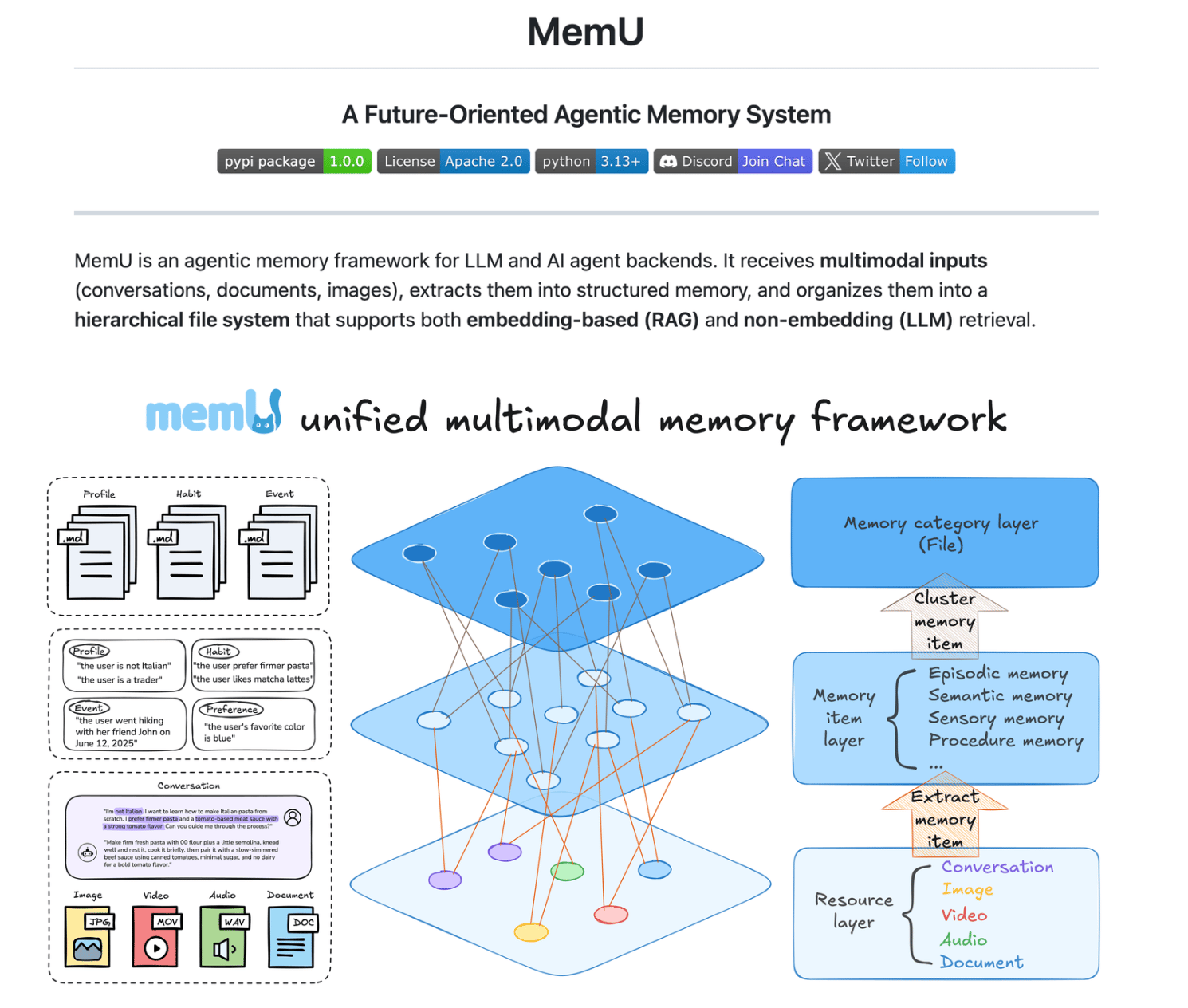
RAG keeps lying to your agents, and nobody's talking about it. Embedding-based retrieval returns "semantically similar" results all the time—but similar doesn't mean correct, and for long-running agents making decisions over time, that's a critical flaw.
memU is a new open-source memory framework that takes a different approach: instead of making vector search smarter, it asks what should never be retrieved via embeddings at all. The system organizes memory into a three-layer hierarchy (Resources → Items → Categories), storing each category as a readable Markdown file that LLMs can directly comprehend. When a query arrives, the model reads the relevant memory files using semantic understanding rather than vector similarity, only falling back to traditional RAG when needed.
It's inspired by how Anthropic's skill.md pattern works: explicit, inspectable, and stable over time.
Key Highlights:
Non-Embedding Retrieval - LLMs read structured Markdown files directly, enabling deep semantic understanding instead of ranking vectors for accuracy-critical scenarios.
Full Traceability - Track any memory from raw data → extracted items → category summaries and back, making debugging and auditing straightforward.
Multimodal Support - Process conversations, documents, images, audio, and video into a unified memory hierarchy with cross-modal retrieval.
Self-Evolving Structure - Memory categories adapt and reorganize based on usage patterns, so the system improves without manual curation.
Business news worth its weight in gold
You know what’s rarer than gold? Business news that’s actually enjoyable.
That’s what Morning Brew delivers every day — stories as valuable as your time. Each edition breaks down the most relevant business, finance, and world headlines into sharp, engaging insights you’ll actually understand — and feel confident talking about.
It’s quick. It’s witty. And unlike most news, it’ll never bore you to tears. Start your mornings smarter and join over 4 million people reading Morning Brew for free.
Claude Code On-the-Go 🚶♂️🤳
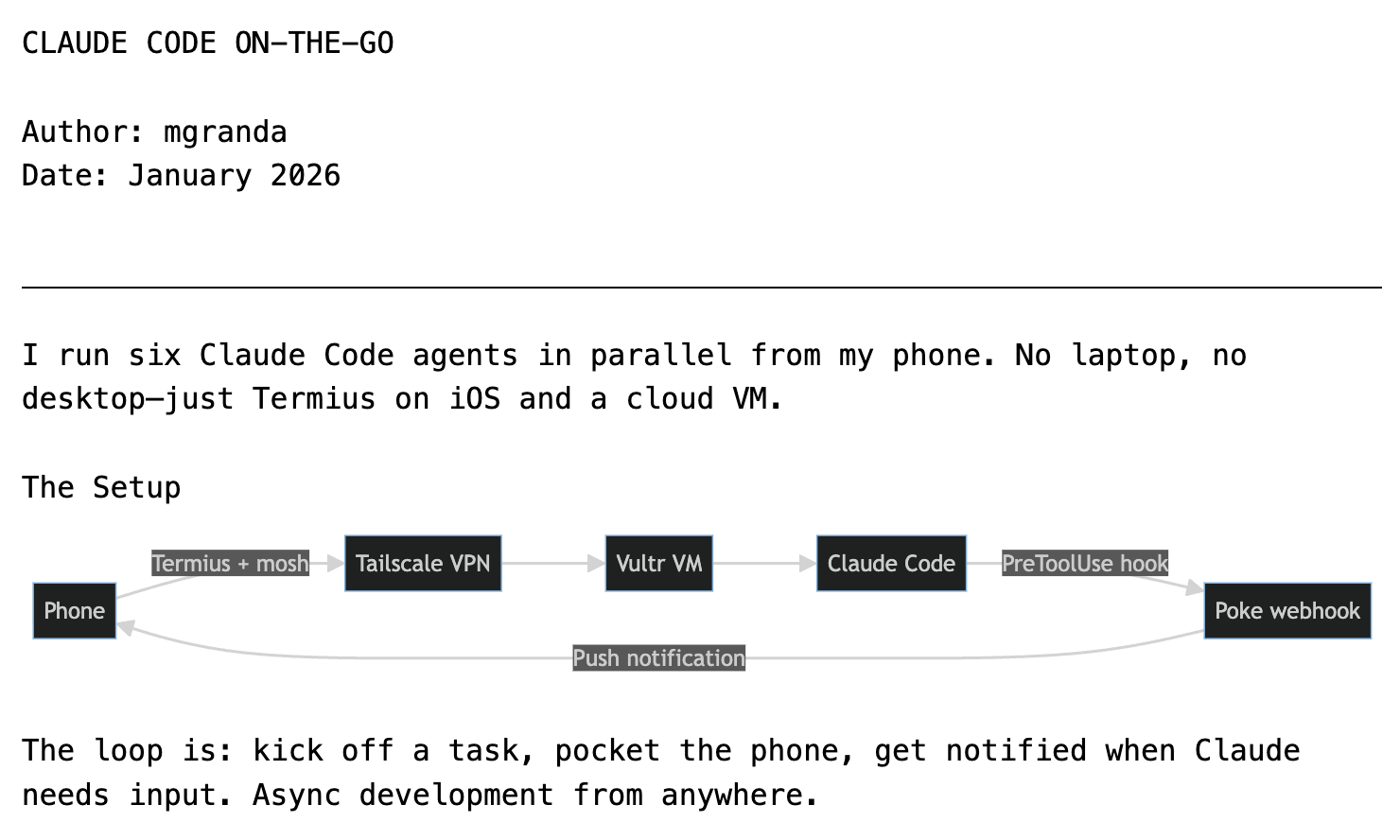
This is probably the 3rd post on Claude Code on the phone with Termius and we had to cover this particular setup because it's the most complete mobile-first development workflow.
A developer is running six Claude Code agents in parallel from his phone. No laptop, no desktop, just Termius on iOS connected to a cloud VM through VPN.
The architecture is elegantly simple: Termius connects via mosh (which survives WiFi-to-cellular transitions and dead zones) to a Vultr VM running Claude Code. The real magic? Push notifications through Poke webhooks that ping your phone whenever Claude needs input. Kick off a refactor on the train, pocket your phone, get notified when Claude has a question, respond, and continue.
Development now fits into the gaps of your day — reviewing PRs while waiting for coffee, fixing bugs from the couch.
Key Highlights:
Network-Resilient Connection - Mosh keeps sessions alive through network switches and phone sleep; tmux auto-attaches on login so you pick up exactly where you left off, even hours later.
Push Notification Workflow - A Claude Code hook fires on
AskUserQuestion, POSTs to Poke's webhook, and your phone buzzes with the actual question in the notification.Parallel Agent Development - Git worktrees let each feature branch run its own Claude agent in separate tmux windows, with deterministic port allocation to prevent conflicts.
Cost-Controlled Security - The VM costs $0.29/hr with Tailscale-only access (no public SSH), making it both disposable and bounded in risk.
Quick Bites
The Modern AI PM in the age of Agents
The PM role is quietly being rewritten. This blog argues that when vibe coding lets you turn a problem statement and ship working code in an hour, the bottleneck shifts upstream - from engineering capacity to knowing what's actually worth building. Context curation, problem shaping, and taste become the core skills; the spec-to-handoff-to-iteration cycle just collapses. It’s a great read, much more than just “AI is changing everything” posts, and you’ll definitely take something away from this.
NVIDIA kicks off the next generation of AI with Vera Rubin
One of the anticipated releases at CES 2026 is finally here! NVIDIA revealed its Vera Rubin platform, a superchip that pairs one Vera CPU with two Rubin GPUs, promising 10x lower inference costs and 4x fewer GPUs needed for training MoE models compared to Blackwell. The rack-scale NVL72 system packs 72 GPUs with 260TB/s of bandwidth - more than the entire internet, says Jensen Huang! The first cloud deployments are coming in H2 2026 from AWS, Google Cloud, Microsoft, and others.
Tools of the Trade
Baserow - An open-source no-code platform for building databases, apps, automations, and AI agents - essentially a self-hostable Airtable alternative with HIPAA/SOC 2 compliance. It's API-first with a plugin architecture, built on Django/Vue/PostgreSQL, so you get spreadsheet simplicity with proper database capabilities underneath.
FracturedJson - A JSON formatter that sits between minified and fully expanded output. It intelligently keeps simple arrays and objects on single lines while aligning similar structures into readable tables. Available as a .NET library, JavaScript package, VS Code extension, and browser tool.
Specific - Build backend APIs using natural-language specs and tests instead of code. You describe what you want, and it generates and deploys a working system with database, auth, and external API support. It's spec-driven development taken to its logical endpoint, where the specification is the source of truth.
Awesome LLM Apps - A curated collection of LLM apps with RAG, AI Agents, multi-agent teams, MCP, voice agents, and more. The apps use models from OpenAI, Anthropic, Google, and open-source models like DeepSeek, Qwen, and Llama that you can run locally on your computer.
(Now accepting GitHub sponsorships)

Hot Takes
We should be praying for technology acceleration because on the other side, lies immortality.
claude code will probably make 50,000 people millionaires if not more
Deep work had a good run, but it’s time to move on.
The best way to do high leverage work now is to fire off as many agents as possible the moment you roll out of bed, checking in on them throughout the day until you go to sleep.
No long focused stretches necessary.
That’s all for today! See you tomorrow with more such AI-filled content.
Don’t forget to share this newsletter on your social channels and tag Unwind AI to support us!
PS: We curate this AI newsletter every day for FREE, your support is what keeps us going. If you find value in what you read, share it with at least one, two (or 20) of your friends 😉
Reply