- unwind ai
- Posts
- Google's Open-source A2UI Protocol
Google's Open-source A2UI Protocol
+ GPT Image 1.5 in ChatGPT and API


Shubham Saboo & Gargi Gupta
December 17, 2025
In partnership with

Today’s top AI Highlights:
& so much more!
Read time: 3 mins
AI Tutorial

Here’s a comprehensive breakdown of 8 production patterns for building agent teams. All backed by real architectural principles.
Each pattern solves a specific problem:
Sequential Pipeline – Data processing that needs predictable order. Parser extracts text, Extractor pulls structured data, Summarizer generates output.
Coordinator/Dispatcher – Intent-based routing. Analyzes requests and sends to billing specialist vs tech support specialist based on descriptions.
Parallel Fan-Out/Gather – Eliminate sequential bottlenecks. Run security scan, style check, and performance analysis simultaneously. Synthesize at the end.
Hierarchical Decomposition – Handle tasks too large for one context window. Top-level ReportWriter delegates to ResearchAssistant, which manages WebSearch and Summarizer agents.
Generator + Critic – Quality enforcement with conditional looping. Generate SQL → validate syntax → regenerate if errors → exit when pass.
Iterative Refinement – Qualitative improvement loop. Draft → critique → refine → repeat until quality threshold met.
Human-in-the-Loop – Safety net for irreversible actions. Agent processes routine work, pauses for human approval on high-stakes decisions.
Composite – Real production systems combine patterns. Coordinator routes to parallel search, results go through generator-critic loop before delivery.
We share hands-on tutorials like this every week, designed to help you stay ahead in the world of AI. If you're serious about leveling up your AI skills and staying ahead of the curve, subscribe now and be the first to access our latest tutorials.
Latest Developments
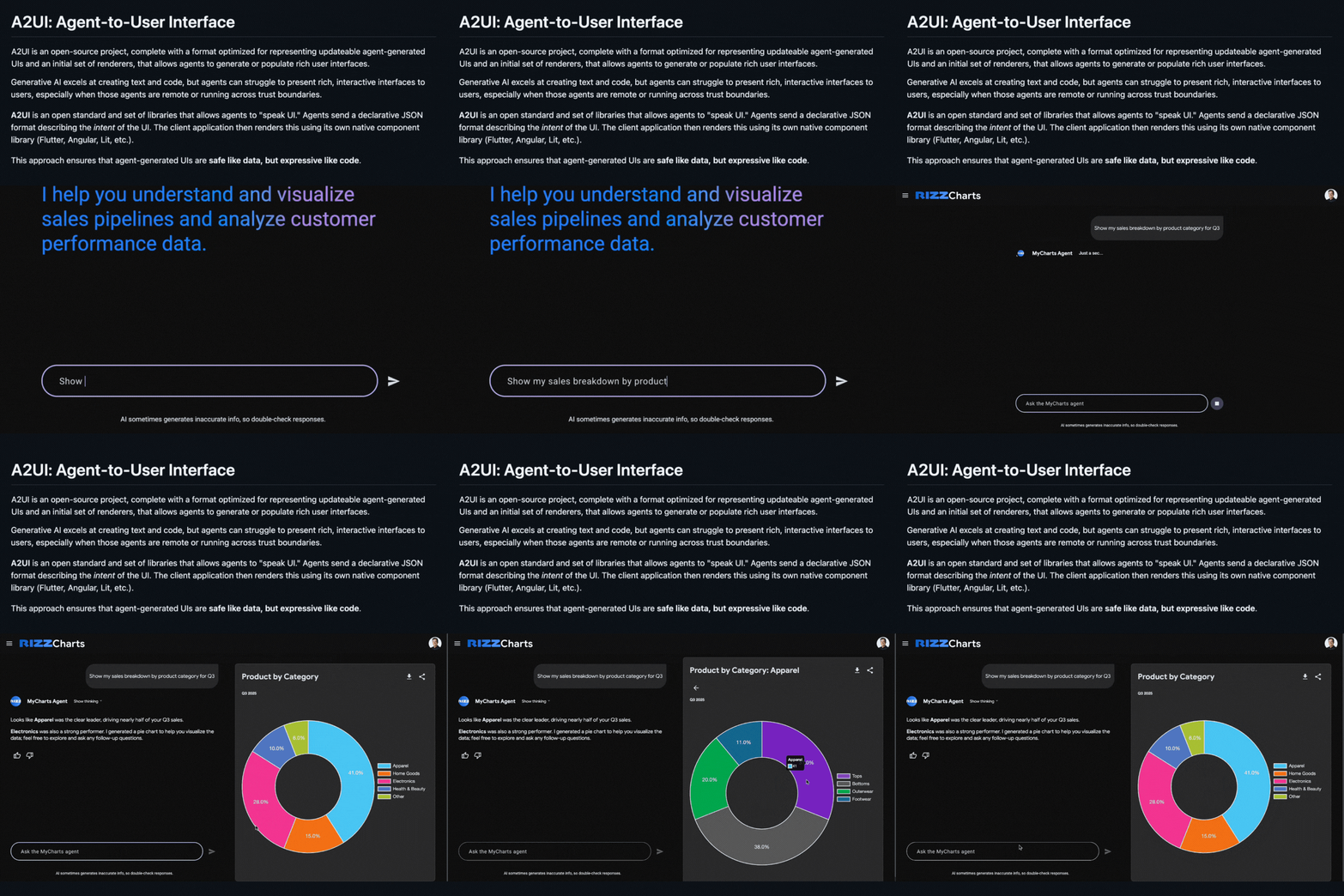
AI agents can finally generate interactive UIs that feel native to your app.
Google just open-sourced A2UI (Agent-to-User Interface), a protocol that lets agents stream rich UI components like forms, date pickers, and interactive cards directly to users across web, mobile, and desktop platforms.
Instead of dumping walls of text or embedding clunky HTML widgets, agents now send lightweight JSON descriptions that your app renders using its own component library. Built with contributions from CopilotKit and designed specifically for LLMs to generate incrementally, A2UI solves the core problem of how agents safely deliver interactive experiences across trust boundaries. The protocol is Apache 2.0 licensed, and already powering production systems like Google Opal and Gemini Enterprise.
Key Highlights:
Declarative Security Model - Agents can only request components from your pre-approved catalog, eliminating code execution risks while maintaining full expressiveness. Your client controls what's possible, agents control what's rendered.
Framework-Agnostic Rendering - Single agent response works across Angular, Flutter, Lit, React, and native mobile with current renderer support for web (Lit/Angular) and mobile/desktop (Flutter GenUI SDK). React renderer coming Q1 2026.
Progressive Streaming Architecture - Flat component list with ID references enables LLMs to build UIs incrementally without perfect JSON. Users see interfaces rendering in real-time as agents generate them, with built-in support for updates and corrections.
Production Integration Paths - Direct API access via A2A protocol for multi-agent systems, built-in support in AG UI/CopilotKit for full-stack React apps, or standalone renderers for custom implementations.
Check out the code and documentation, along with sample use cases.
Turn AI Into Your Income Stream

The AI economy is booming, and smart entrepreneurs are already profiting. Subscribe to Mindstream and get instant access to 200+ proven strategies to monetize AI tools like ChatGPT, Midjourney, and more. From content creation to automation services, discover actionable ways to build your AI-powered income. No coding required, just practical strategies that work.

A Claude Code plugin just dropped that gives Claude real memory across sessions.
Not through prompt engineering tricks, but by automatically capturing what happens during your work and injecting compressed observations when you restart.
Claude-Mem works like a persistent context layer that survives session crashes, context limits, and those annoying moments when you have to restart because you hit token caps.
This open-source tool uses lifecycle hooks to watch everything Claude does, extracts the meaningful bits through the Claude Agent SDK, and stores them in a SQLite database with full-text search. What makes it interesting is the progressive disclosure approach: you see an index of past observations with token costs upfront, then pull full details only when needed - mimicking how humans actually retrieve memories instead of dumping everything into context at once.
Key Highlights:
Automatic Context Injection - No manual commands needed; recent observations auto-inject at session start with type indicators (🔴 critical, 🔵 informational) and token costs displayed upfront, helping Claude decide whether to fetch details or read source code directly.
Multi-Layer Memory Retrieval - Layer 1 shows observation indexes with token costs, Layer 2 fetches full narratives on-demand via MCP search, Layer 3 accesses original source code and complete transcripts for perfect recall.
10 Search Operations - Search by observations, sessions, prompts, concept tags, files, types, recent context, timeline around specific points, timeline by query match, plus API help—all accessible through the mem-search skill or HTTP endpoints.
Installation - Run
/plugin marketplace add thedotmack/claude-memand/plugin install claude-memin Claude Code, then restart; Bun and uv auto-install if missing, worker service starts automatically, memory capture begins immediately.
Quick Bites
GPT Image 1.5 is here in ChatGPT and API
OpenAI's response to Nano Banana buzz: ChatGPT Images (GPT Image 1.5) for image generation and editing, with 4x speed improvements and tighter instruction adherence for edits. The model now handles detailed modifications while keeping composition, lighting, and other elements intact. Plus great text rendering. The upgrade rolls out to all tiers today, including free users. In the API, the model is priced at $8 input and $32 output per million tokens, 20% cheaper than GPT Image 1.
Meta releases SAM Audio for sound segmentation
Meta just dropped SAM Audio, extending their Segment Anything toolkit to sound isolation. The model lets you pull out specific audio - vocals, instruments, background noise - using simple text prompts, visual clicks on video objects, or time-span markers, all combinable for precise control. The model is available to download and live on their Segment Anything Playground, though it still struggles with highly similar sounds like isolating one voice from a choir.
Letta Code - open-source first memory-first coding agent
Letta just dropped Letta Code, a memory-first CLI coding agent that actually remembers what you've worked on. Unlike typical coding agents that start fresh each session, this one persists memory across interactions, learns your codebase through an /init command, and can even capture reusable skills from past work. It's currently the top model-agnostic open-source harness on TerminalBench, matching performance of provider-specific tools like Claude Code and Gemini CLI. Available now via npm install or from source.
Anthropic's new Agent Mode shows chat interface has limits
Anthropic is testing a new Agent mode for Claude that splits tasks into dedicated sections - Research, Analyze, Write, Build, and "Do More" - each with its own configuration options for depth, sources, and output formats. Instead of endless chat threads, you'll toggle into a structured interface where you can set parameters upfront (peer-reviewed sources only, please) and watch Claude work through a progress tracker on the right. Think less conversational assistant, more autonomous project manager that actually knows what it's doing.
Some QoL updates for Claude Code users
Anthropic shipped four quality-of-life upgrades to Claude Code that address the small friction points for developers:
Enhanced diff highlighting with expanded language coverage
Contextual prompt suggestions (hit Enter to accept, Tab to modify)
/pluginscommand for discovering and installing from the official directoryGuest pass system for temporary team access
Tools of the Trade
CC - Google's experimental AI productivity agent that emails you a daily briefing by analyzing your Gmail, Calendar, and Drive data. You can also email CC directly at
[your-username][email protected]to request summaries or add tasks. Currently US/Canada only with priority access for Google AI Ultra and paid subscribers.Auditor - Antidote to vibe coding. It’s is a database-first static analysis tool that indexes your entire codebase into SQLite databases, for sub-second queries for security vulnerabilities, architectural analysis, and call graph traversal across Python, JavaScript/TypeScript, Go, Rust, Bash, and Terraform.
VibeCSS - A Chrome extension that lets you modify CSS and HTML on any live website using natural language prompts. Select an element, describe the change, and AI applies it in real-time. Changes are temporary (cleared on reload) and work without opening dev tools.
Awesome LLM Apps - A curated collection of LLM apps with RAG, AI Agents, multi-agent teams, MCP, voice agents, and more. The apps use models from OpenAI, Anthropic, Google, and open-source models like DeepSeek, Qwen, and Llama that you can run locally on your computer.
(Now accepting GitHub sponsorships)

Hot Takes
UI is pre-AI.
There is a massive opportunity, right now, for anyone who can walk into a company and automate the grunt work they do every day.
It doesn't matter what programming language you use, or libraries you like, or whether you know what micro-services do, or if you like Claude Code or Cursor.
No one cares about any of that.
If you can identify a problem and convince them you can solve it, you'll make a killing.
~ Santiago
That’s all for today! See you tomorrow with more such AI-filled content.
Don’t forget to share this newsletter on your social channels and tag Unwind AI to support us!
PS: We curate this AI newsletter every day for FREE, your support is what keeps us going. If you find value in what you read, share it with at least one, two (or 20) of your friends 😉
Reply